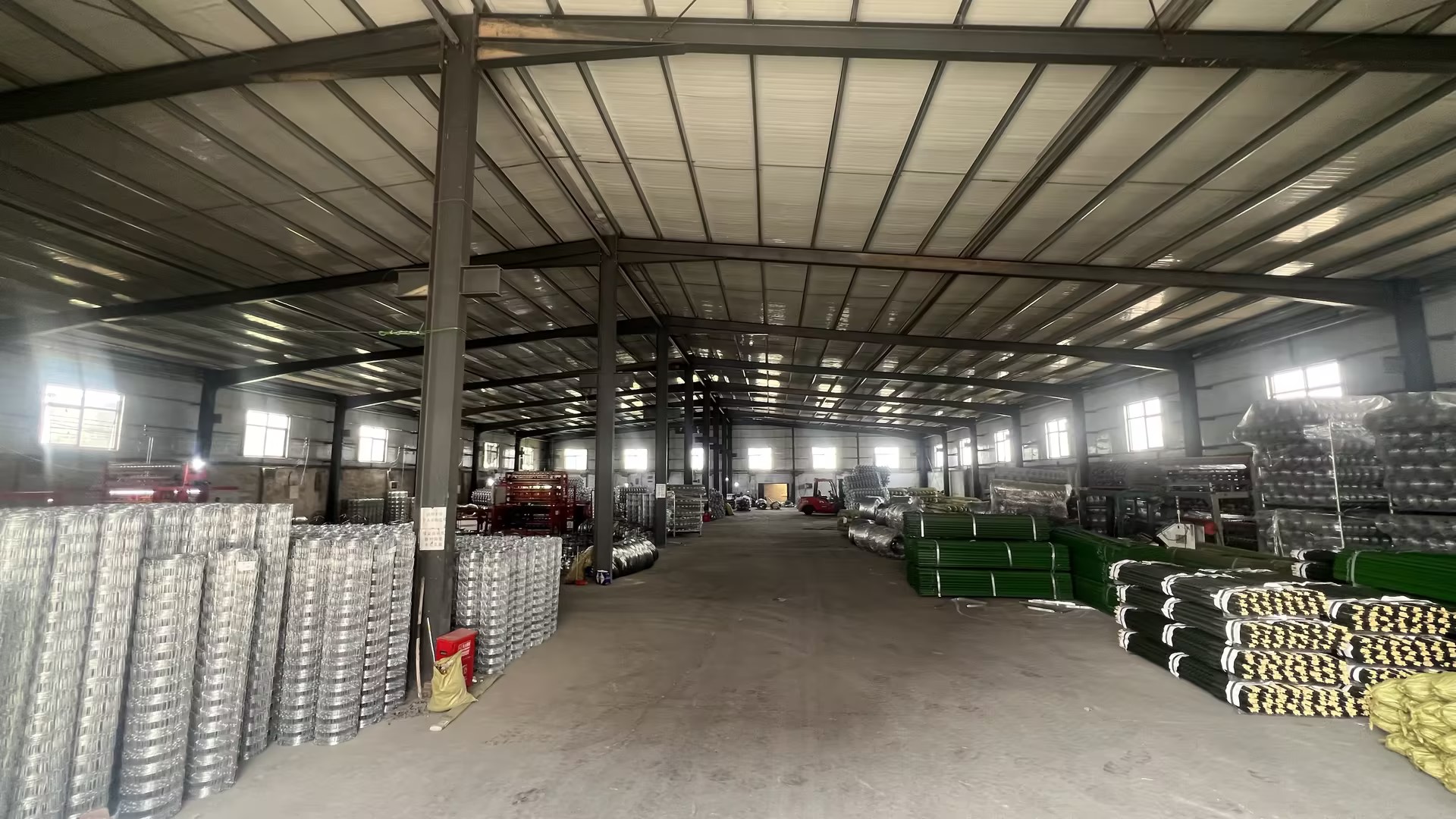
Barbed wire is the most cost-effective way to secure a perimeter. But the specs matter — core wire gauge, strand count, barb spacing and coating all affect how well the wire performs, how long it lasts and how much deterrent it provides. Get any one of these wrong and you end up with a fence that sags, rusts or simply does not keep anything out.
At a glance
- Core wire: 1.4–1.8 mm light duty, 2.0–2.5 mm medium duty, 2.5–2.8 mm heavy duty.
- Strand: single strand for farm boundaries; double strand for security perimeters.
- Barb spacing: 75 mm for high security, 100 mm standard, 150 mm economy.
- Coating: regular zinc (40 g/m²) for general use; heavy zinc (200/230 g/m²) for severe climates; PVC coated for extra protection.
- Match the spec to the job: farm perimeters need different barbed wire than military compounds.
Here is a factory-level breakdown of every barbed wire specification you need to understand before ordering, with practical guidance on matching each spec to your application.
Core wire gauge: 1.4 mm to 2.8 mm
The core wire — also called the line wire or strand wire — is the backbone of every barbed wire roll. Its diameter determines how much tensile strength the wire has, how resistant it is to cutting, and how easy it is to handle during installation.
Barbed wire core wire typically ranges from 1.4 mm to 2.8 mm. Here is how the three bands compare:
| Core Wire Gauge | Diameter Range | Weight & Feel | Best For |
|---|---|---|---|
| Light duty | 1.4 – 1.8 mm | Light, easy to unroll and tension by hand | Farm boundaries, temporary enclosures, livestock control on low-risk perimeters |
| Medium duty | 2.0 – 2.5 mm | Good balance of strength and workability | General purpose perimeter fencing, agricultural security, medium-risk areas |
| Heavy duty | 2.5 – 2.8 mm | Stiff, requires wire strainers and tools | High-security perimeters, military zones, industrial sites, maximum cutting resistance |
A thicker core wire is harder to cut with hand tools and holds tension better over long runs. But it is also heavier per roll, costs more to ship, and takes more effort to install. For most agricultural fencing, a 1.6–2.0 mm core wire is the sweet spot. Step up to 2.5 mm or above only when security is the primary concern.
The barb wire itself is usually a slightly thinner gauge — typically 1.5–2.0 mm — because it only needs to be sharp, not structural.
Single strand vs double strand
Barbed wire comes in two strand configurations, and the choice is straightforward once you understand what each one delivers:
Single strand barbed wire has one core wire with barbs attached at regular intervals. It is lighter, cheaper per metre, and faster to install. The barbs still deter animals and people, but the single line offers less physical resistance. This is the standard choice for:
- Farm and pasture boundaries where the goal is livestock control, not fortress-level security.
- Topping an existing fence (field fence or chain link) to add a deterrent layer without over-building.
- Temporary fencing or rotational paddock divisions where speed of installation matters.
Double strand barbed wire twists two barbed wires together into a single line. The result is a thicker, more visible barrier that is harder to push through, harder to cut, and presents barbs at multiple angles. Use double strand when:
- The perimeter faces human intrusion risk — industrial compounds, warehouses, restricted zones.
- You want maximum visual deterrence. Double strand looks substantially more imposing than a single line.
- Regulations or security audits require a higher rated barrier.
Many perimeter fences use a mix: single strand across open agricultural runs and double strand at gates, corners and high-risk sections. There is no rule that says you must use the same configuration everywhere on a single fence line.
Barb spacing: 75 mm, 100 mm, 150 mm
The distance between barbs along the core wire is one of the most important specs for deterrence. Standard options are 75 mm, 100 mm and 150 mm, and each serves a different level of security:
| Barb Spacing | Deterrence Level | Typical Use |
|---|---|---|
| 75 mm (3 in) | Maximum — barbs every 75 mm means almost no gap to push through | High-security perimeters, military zones, prison boundaries, anti-climb topping |
| 100 mm (4 in) | Standard — good balance of deterrence and cost | General security fencing, farm boundaries, industrial compounds, highway guardrails |
| 150 mm (6 in) | Economy — wider gaps but still a clear deterrent | Agricultural livestock fencing, low-risk boundaries, large-acreage farms where cost per metre matters most |
Closer barb spacing means more steel per roll, which increases both cost and weight. For a typical farm perimeter, 100 mm spacing is the industry standard and the most common specification we produce. Move to 75 mm only when security requirements justify the added cost, and use 150 mm when the fence is primarily for livestock guidance on a tight budget.
Barbs are typically 4-point (two barbs twisted around the core wire, giving four sharp points) or 2-point (one barb, two points). Four-point barbs are the standard for perimeter security.
Zinc coating for barbed wire
Barbed wire is exposed to rain, humidity and UV year-round, so the zinc coating is what decides whether the wire lasts 3 years or 30. The same coating grades that apply to other wire products apply here:
| Coating Grade | Method | Expected Service Life | Best For |
|---|---|---|---|
| Regular zinc (40 g/m²) | Hot-dip galvanised | 5–10 years | Dry inland farm boundaries and general agricultural use |
| Heavy zinc (200/230 g/m²) | Heavy hot-dip galvanised | 20–30+ years | Severe marine, tropical or high-rainfall environments |
| PVC coated | HDG core + PVC sheath | 15–30+ years | Coastal or decorative applications |
PVC coated barbed wire is an alternative for corrosive environments. The PVC sheath adds a physical moisture barrier on top of the galvanised layer and is available in green, black or grey for camouflage or aesthetic purposes. It is common in coastal areas and in applications where the wire must blend into a landscape.
As a rule of thumb: match the coating to your climate, not to your budget. A cheap electro-galvanised wire that rusts in three years costs more in replacement labour and downtime than a regular or heavy zinc hot-dip wire that runs for decades. For a detailed breakdown, see our guide to zinc coating.
Common applications
Barbed wire is used across agriculture, security and infrastructure. The spec you need depends on the job:
Farm perimeter and livestock fencing. The most common use. Single strand, 1.6–2.0 mm core wire, 100–150 mm barb spacing, regular to heavy zinc coating. Usually run on top of a field fence to stop cattle or sheep from jumping or leaning over the top wire.
Security perimeters. Military compounds, industrial sites, warehouses and restricted zones. Double strand, 2.0–2.5 mm core wire, 75–100 mm barb spacing, heavy zinc coating. Often combined with chain link fence panels for a layered barrier.
Highway and road guardrails. Barbed wire is frequently installed on top of highway guardrails and median barriers as an anti-climb measure. Single strand, 2.0 mm core, 100 mm spacing, heavy zinc coating for long-term outdoor exposure.
Topped on field fence for extra deterrence. Adding one or two lines of barbed wire above a field fence is the most cost-effective way to upgrade from a livestock fence to a security fence. It prevents animals from pushing over the top and discourages casual human entry.
Installation basics
Barbed wire is straightforward to install, but a few principles make the difference between a fence that sags in a season and one that stays tight for years:
- Run on top of an existing fence or as standalone. Most barbed wire is installed as a topper on field fence or chain link. Standalone barbed wire fences use 3–5 strands spaced evenly between posts.
- Use with steel or timber posts. Steel Y posts (star pickets) are the standard for barbed wire fencing — they are fast to drive, hold staples well and last decades. Timber strainer posts are needed at corners and ends for tension anchoring.
- Tension with a wire strainer. Barbed wire must be tensioned to prevent sagging. Use a wire strainer (come-along or ratchet type) at each run. Over-tensioning can snap lighter gauge wire, so match your tensioning effort to the core wire diameter.
- Post spacing. Standard spacing is 2.5–3.5 metres depending on terrain and wire gauge. Tighter spacing on hills and curves, wider on flat straight runs.
- Safety. Always wear heavy gloves when handling barbed wire. Unroll from the outside of the coil, not the inside, to avoid tangles. Work with a partner — one person unrolling while the other tensions and staples.
Need barbed wire for your perimeter?
As a factory, we produce barbed wire in all standard specifications — single and double strand, 1.4–2.8 mm core wire, 75/100/150 mm barb spacing, and zinc coating from regular (40 g/m²) to heavy (200/230 g/m²). Custom configurations are available. Browse the full barbed wire specifications on our homepage or send us your requirements for a factory-direct quote.