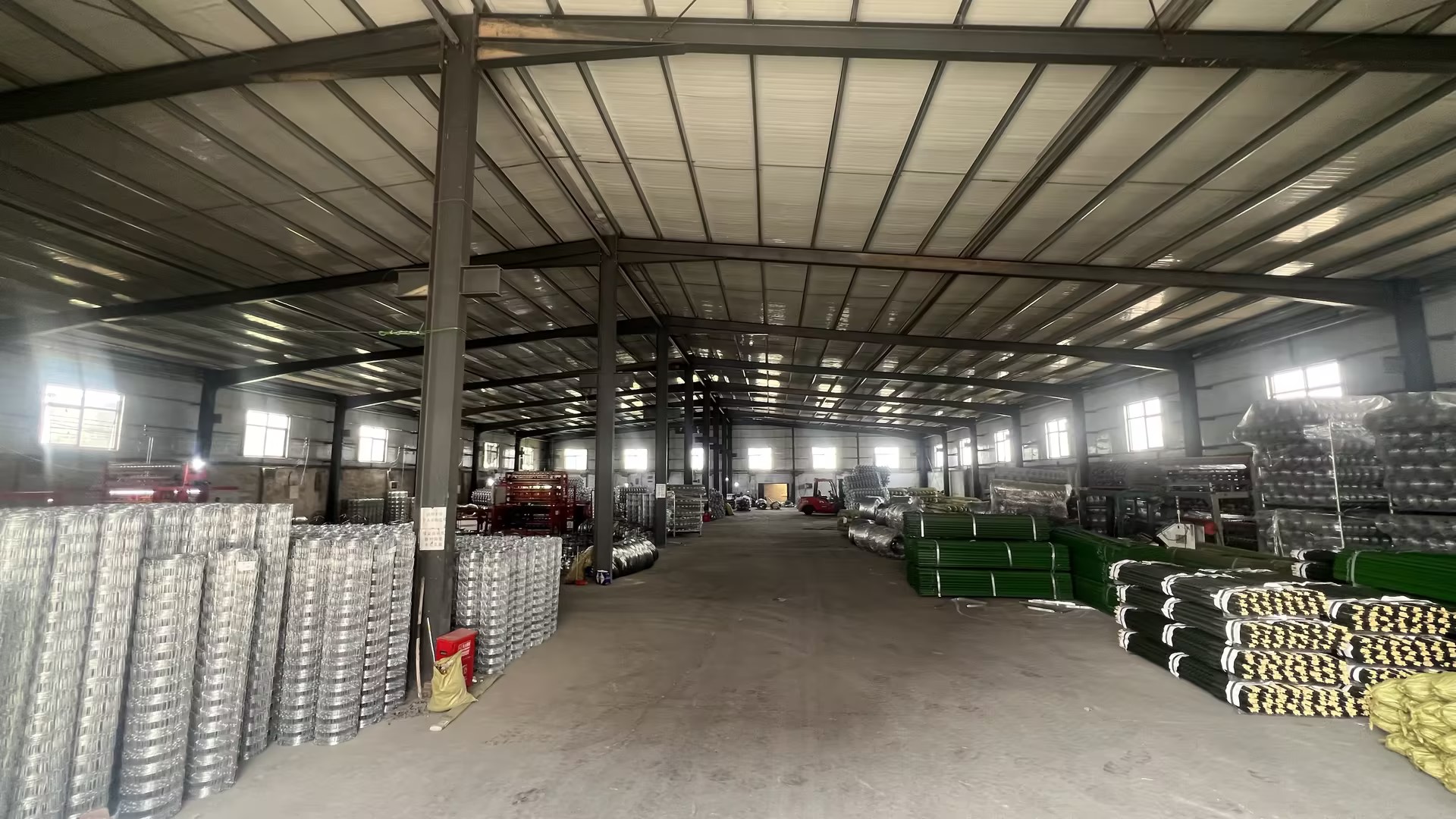
If you are buying field fence for the first time, the choice between hinge joint and ring lock knots is the single decision that most affects how the fence performs in the paddock. Both are high-tensile, galvanised stock fences — but they behave very differently under pressure, and picking the wrong one means a fence that sags, bends or fails years too early.
At a glance
- Hinge joint wraps the line wire around the stay, creating a hinge that flexes and springs back.
- Ring lock crimps a steel ring around every junction, producing a rigid, square mesh.
- Choose hinge joint for cattle, sheep, hilly ground and long rural runs; choose ring lock for deer, high-pressure stock and fixed boundaries.
- A field fence size code such as 8/90/30 means 8 line wires, 90 cm height, 30 cm stay spacing.
- We weave both knots to custom height, line-wire count and stay spacing.
Here is how a factory thinks about the two knot types, and a simple framework for matching the fence to your stock and your country.
What is a hinge joint fence?
In a hinge joint fence, the horizontal line wire wraps around the vertical stay wire, forming a hinge at each junction. When an animal leans, pushes or runs into it, that hinge flexes and then springs back to shape instead of taking a permanent set.
This flexibility is exactly what you want for general livestock and for ground that is anything but flat:
- Cattle and sheep — the give absorbs the weight of animals leaning and rubbing without distorting the mesh.
- Hilly or undulating country — the fence rides the contour of the land, so you are not fighting the terrain to keep it tight.
- Long rural runs — quick to roll out and tension, and forgiving if a post moves slightly over the seasons.
What is a ring lock fence?
In a ring lock fence, a separate steel ring is crimped around each wire junction, locking the vertical and horizontal wires together. The result is a rigid, square mesh that holds its shape rather than flexing.
That rigidity is the right choice when the fence has to stay square under sustained, concentrated pressure:
- High-pressure stock — bulls, rams and densely stocked paddocks where animals push constantly against one line.
- Deer and wildlife exclusion — tall fences that must not deform when animals hit them at speed.
- Fixed boundaries — along roads or property lines where you want the mesh to look square and stay square for decades.
Quick comparison
| Factor | Hinge Joint | Ring Lock |
|---|---|---|
| Junction | Wrapped hinge | Locked steel ring |
| Behaviour under load | Flexes, absorbs impact, springs back | Rigid, holds its shape |
| Best for | Cattle, sheep, mixed livestock | Deer, high-pressure stock, exclusion |
| Terrain | Undulating, long runs | Flat, fixed boundaries |
| Priority | Value & flexibility | Maximum rigidity |
How to decide
Strip it back to three questions:
- What is the pressure? Steady leaning and rubbing from cattle and sheep favours hinge joint. Constant, concentrated pushing or high-speed impact favours ring lock.
- What is the ground like? Hilly, contoured or long runs favour the forgiving hinge joint. Flat, straight, fixed boundaries favour ring lock.
- What is the priority — value or rigidity? Hinge joint generally gives the best value and easiest install; ring lock costs a little more for the rigidity.
Many farms run both: hinge joint across general paddocks, and ring lock where the pressure or the stakes are highest — deer yards, boundary lines, exclusion fencing. There is no single "best" knot, only the right knot for each fence line.
Reading a field fence size code
Field fence is described by a three-number size code such as 8/90/30. Once you can read it, comparing specs across suppliers becomes straightforward:
- First number — line wires: the count of horizontal wires (8 in this example). More line wires means a denser, stronger fence.
- Second number — height: the fence height in centimetres (90 cm).
- Third number — stay spacing: the distance between the vertical stay wires (every 30 cm). Closer spacing — say 15 cm — gives a tighter mesh that holds smaller or more determined animals.
So an 8/90/30 has 8 horizontal wires, stands 90 cm tall, with verticals every 30 cm. If you are fencing lambs or goats, drop the stay spacing; if you are fencing deer, push the height up. We weave to custom codes, so you are not limited to a standard chart.
Before you buy: three checks
Knot type is only half the story. Before you commit to a container, confirm three things with any supplier — a real factory will answer all three without hesitation:
- Wire diameter and tensile grade. Ask for the line-wire and stay-wire diameters and the tensile range. High-tensile wire lets you run lighter, longer and tighter.
- Zinc coating, in writing. Ask for the coating weight in g/m² and the galvanising process. This is what decides service life — not the knot.
- A physical sample. A knot and wire sample tells you more than any photo. It lets you feel the spring of a hinge joint or the rigidity of a ring lock before you order.
Common mistakes that cancel out the right knot
Even the correct knot type underperforms if the fence is built wrong. The three we see most often:
- Over-tensioning a hinge joint. The hinge needs room to flex; strain it bar-tight like a plain wire and you lose the spring that makes it forgiving. Tension firmly, not rigidly.
- Weak end assemblies. A fence is only as good as its strainer posts. Skimp on corner and end bracing and even the best mesh will sag within a season.
- Wrong post spacing for the country. Wide spacing saves posts but lets the fence move on hills and under pressure. Tighten spacing on undulating ground and high-traffic lines.
Don't forget the zinc
Whichever knot type you choose, the coating decides how long the fence lasts. Thin electro-galvanised wire can rust within a season, while a heavier hot-dip coating lasts for decades — so specify the zinc weight for your climate, not just the knot. We hot-dip galvanise our field fence and can supply to your required specifications on request. For the detail, see our guide to zinc coating.
And if you are still matching a fence to a particular animal — cattle, sheep or deer — our guide to the best fencing for cattle, sheep and deer walks through height, mesh and spacing for each.
Not sure which knot suits your stock?
As a factory, we weave both hinge joint and ring lock to custom height, line-wire count and stay spacing. Send us your animals and terrain and we'll recommend a spec — or browse the full field fence specifications.