Chain link fence (also called diamond mesh) is one of the most versatile wire fences on the market — used for security perimeters, sports facilities, residential yards, farm boundaries, and temporary construction sites. But the difference between a fence that lasts 5 years and one that lasts 20 comes down to choosing the right spec. This guide walks you through every key parameter so you can specify with confidence.
At a glance
- Wire diameter: 2.0–3.0 mm for general use; 3.55 mm+ for heavy-duty security.
- Mesh opening: 50 mm is the most common; 60 mm is cheaper for large areas; 25–40 mm for small animals or security.
- Surface treatment: choose hot-dip galvanised for outdoor durability, PVC coated for maximum corrosion resistance and colour matching.
- Edge finish: knuckled for safety, twisted/barbed for security.
- Height: 1.5–1.8 m residential, 2.0–2.4 m commercial, 3.0 m high-security.
Wire diameter: how thick is thick enough?
The wire gauge (diameter) is the single biggest factor in how strong and how expensive the fence will be. Chain link is typically supplied in metric diameters from 2.0 mm to 4.0 mm. Here is how each performs:
- 2.0 mm — light-duty. Good for garden enclosures, temporary fencing, and decorative boundaries where security is not a concern. Lowest cost per square metre.
- 2.5 mm (~12.5 gauge) — general purpose. The most popular size for residential yards, dog runs, and light commercial applications. A solid balance of strength and cost.
- 3.0 mm — commercial and industrial. Suitable for security perimeters, school grounds, warehouse compounds, and areas with moderate to high traffic or pressure.
- 4.0 mm — high-security and heavy-duty. Used for prison fencing, military sites, high-value storage yards, and anywhere anti-climb or anti-cut resistance is needed.
| Wire Diameter | Typical Use | Relative Cost |
|---|---|---|
| 2.0 mm | Garden, temporary fencing | Low |
| 2.5 mm | Residential yard, dog run | Medium |
| 3.0 mm | Commercial, industrial perimeter | Medium-High |
| 4.0 mm | High-security, heavy-duty | High |
Pro tip: Tensile strength matters as much as diameter. Our chain link wire is drawn to 350–500 MPa tensile strength, which means a 2.5 mm high-tensile wire can outperform a 3.0 mm mild-steel wire at lower weight and cost.
Mesh opening size: 50 mm vs 60 mm
The diamond mesh opening is measured across the diagonal. The two most common sizes are 50 mm (2 inches) and 60 mm (2.4 inches). Choosing between them comes down to what you are keeping in — or out.
- 50 mm (2″) mesh — tighter weave, better for smaller animals (poultry, rabbits, small dogs), and provides slightly more visual screening. Uses more wire per square metre, so it costs a little more.
- 60 mm (2.4″) mesh — the industry standard for most applications: residential yards, commercial perimeters, sports courts, and general livestock fencing. Slightly lower cost due to less wire per m².
When to choose 50 mm: small animal containment, higher security (harder to get a foothold), or where local regulations require a tighter mesh. When to choose 60 mm: general-purpose fencing where budget and coverage area are the priority.
We also supply custom mesh openings on request — including 25 mm for aviary work and 75 mm for large-scale agricultural runs.
Surface treatment: galvanized vs PVC coated
The coating is what decides how long your chain link fence survives outdoors. There are three main options, each with a different cost-to-durability ratio:
- Electro galvanized (EG) — thin zinc layer, lowest cost. Best for indoor use, sheltered areas, or short-term temporary fencing. Will corrode faster in exposed or coastal environments.
- Hot-dip galvanized (HDG) — the workhorse. The wire is dipped in molten zinc, creating a thick, bonded coating. We stock regular zinc (40 g/m²) and heavy zinc (200 g/m² on 2.0 mm wire, 230 g/m² on 2.5 mm wire). The heavier the coating, the longer the service life. Custom coating grades are available on request. This is the standard choice for outdoor fencing in most climates.
- PVC coated — a layer of PVC plastic is extruded over a galvanized core. Gives the best corrosion resistance and also allows colour matching (green, black, or custom RAL). PVC thickness ranges from 0.5 mm to 1.0 mm. The best option for coastal areas, parks, schools, and anywhere aesthetics matter.
| Surface Treatment | Zinc / PVC | Best For | Service Life |
|---|---|---|---|
| Electro galvanized | Light zinc | Indoor, temporary | 1–3 years |
| Hot-dip galvanized | Regular (40 g/m²) to heavy (200/230 g/m²) | General outdoor | 10–25+ years |
| PVC coated | HDG core + 0.5–1.0 mm PVC | Coastal, decorative, high-corrosion | 15–30+ years |
For the full detail on zinc coating weights and how they affect lifespan, see our zinc coating guide.
Edge types (selvage): twisted, knuckled, barbed
The selvage is how the top and bottom edges of the chain link mesh are finished. This affects safety, security, and where the fence can be used:
- Twisted (or twisted barb) — the standard finish. The wire ends are twisted together, creating a sharp edge. Good for security perimeters where you want a deterrent along the top.
- Knuckled — the wire ends are bent back into a smooth loop. No sharp edges, making it the safe choice for sports facilities, playgrounds, schools, and residential yards where children are present.
- Barbed top / knuckled bottom — the most common combination for security fencing. Barbed edge at the top deters climbing; knuckled edge at the bottom is safe for ground-level contact.
Many customers specify knuckled top and bottom for residential or sports use, and barbed top / knuckled bottom for commercial and industrial security.
Choosing the right height
Chain link fence is supplied in standard heights from 1.0 m to 3.0 m. The right height depends on the application and any local regulations:
- 1.0–1.2 m — garden borders, decorative fencing, low animal enclosures.
- 1.5–1.8 m — residential yard, pool fence (check local pool fence regulations for minimum height), dog run, light commercial.
- 2.0–2.4 m — commercial perimeter, sports facility, warehouse compound, school boundary.
- 3.0 m — high-security, industrial sites, airport boundaries. Often combined with barbed wire or razor wire on top.
Note: Always check your local building code or council regulations. Many jurisdictions require a minimum 1.8 m height for pool fencing and 2.4 m for commercial security perimeters.
Australian Standards: AS 1725 and AS 2423
If you are supplying into the Australian market, two key standards apply:
- AS 1725 — covers chain link fabric and wire mesh fences for general, security, and sports applications. It specifies wire diameter tolerances, mesh opening dimensions, selvage types, and zinc coating minimums.
- AS 2423 — covers zinc-coated wire for fences, specifying the minimum coating mass (in g/m²) for different corrosion environments.
All our chain link fence can be manufactured to meet AS 1725 and AS 2423 requirements. Confirm the standard, wire diameter and coating grade in your inquiry and we will quote and produce to match.
Installation basics
Chain link fence installation follows four main steps. Here is a quick overview to help you plan:
- Set your posts. Dig holes, set terminal (end/corner) posts in concrete first, then run a string line and set line posts at 2.4–3.0 m spacing. Let concrete cure before tensioning.
- Install top rail and tension bars. Thread the top rail through the top of the mesh. Attach tension bars at each terminal post using tension bands.
- Stretch the mesh. Unroll the chain link along the fence line. Use a come-along or fence stretcher to pull the mesh tight between terminal posts. Work from the bottom up — this keeps the mesh aligned and prevents bunching at the top.
- Secure and tie off. Attach the mesh to the top rail and line posts using tie wires or clips every 300–400 mm. Trim excess wire at the ends.
Pro tip: Always stretch from the bottom up. It sounds counter-intuitive, but starting at the bottom prevents the mesh from sagging into a catenary curve and makes it much easier to get even tension across the full height.
Need help choosing the right chain link spec?
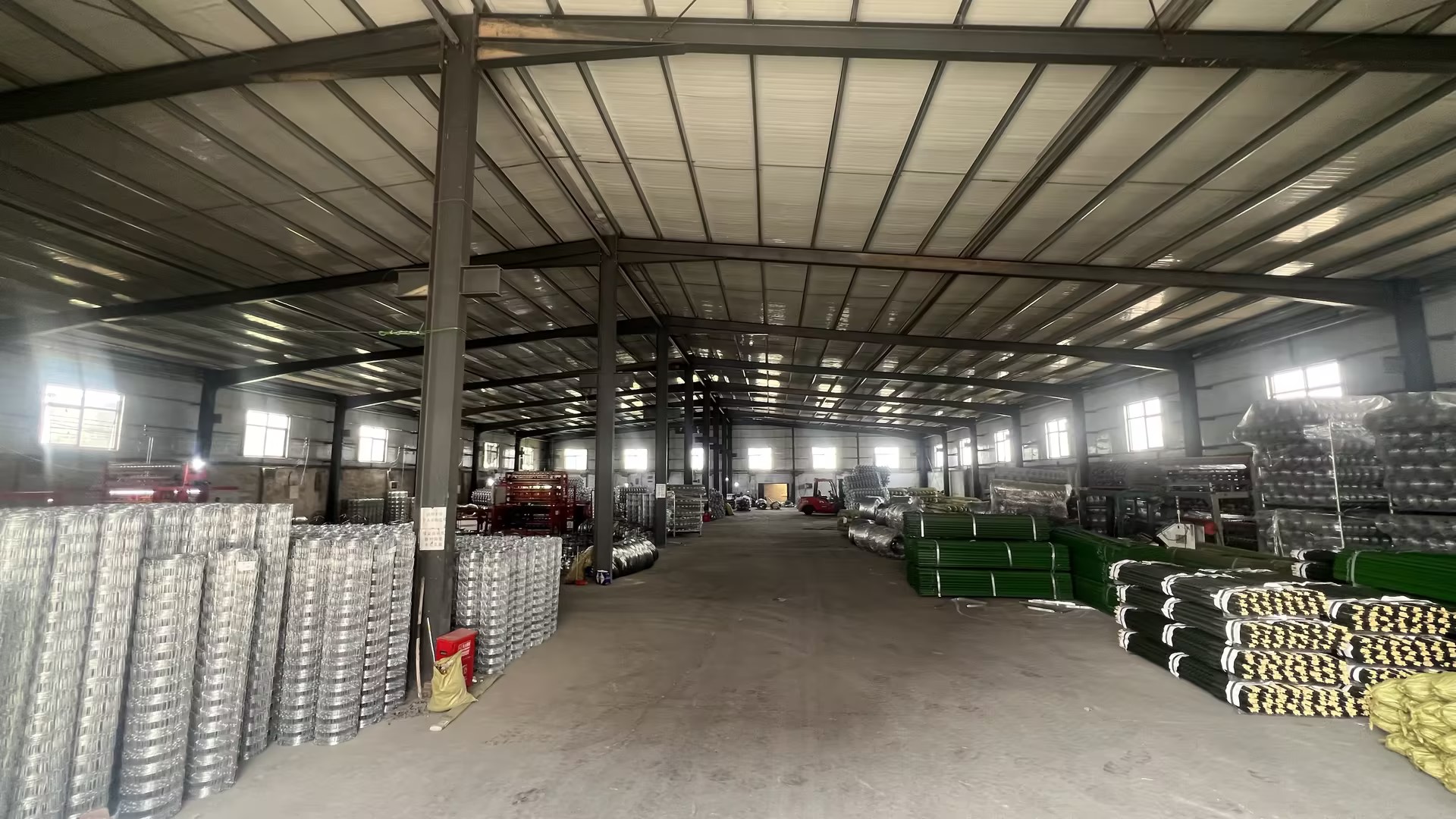
As a factory, we manufacture chain link fence in any wire diameter, mesh opening, height, and surface finish. Send us your application and we will recommend a spec — or browse the full chain link fence specifications.