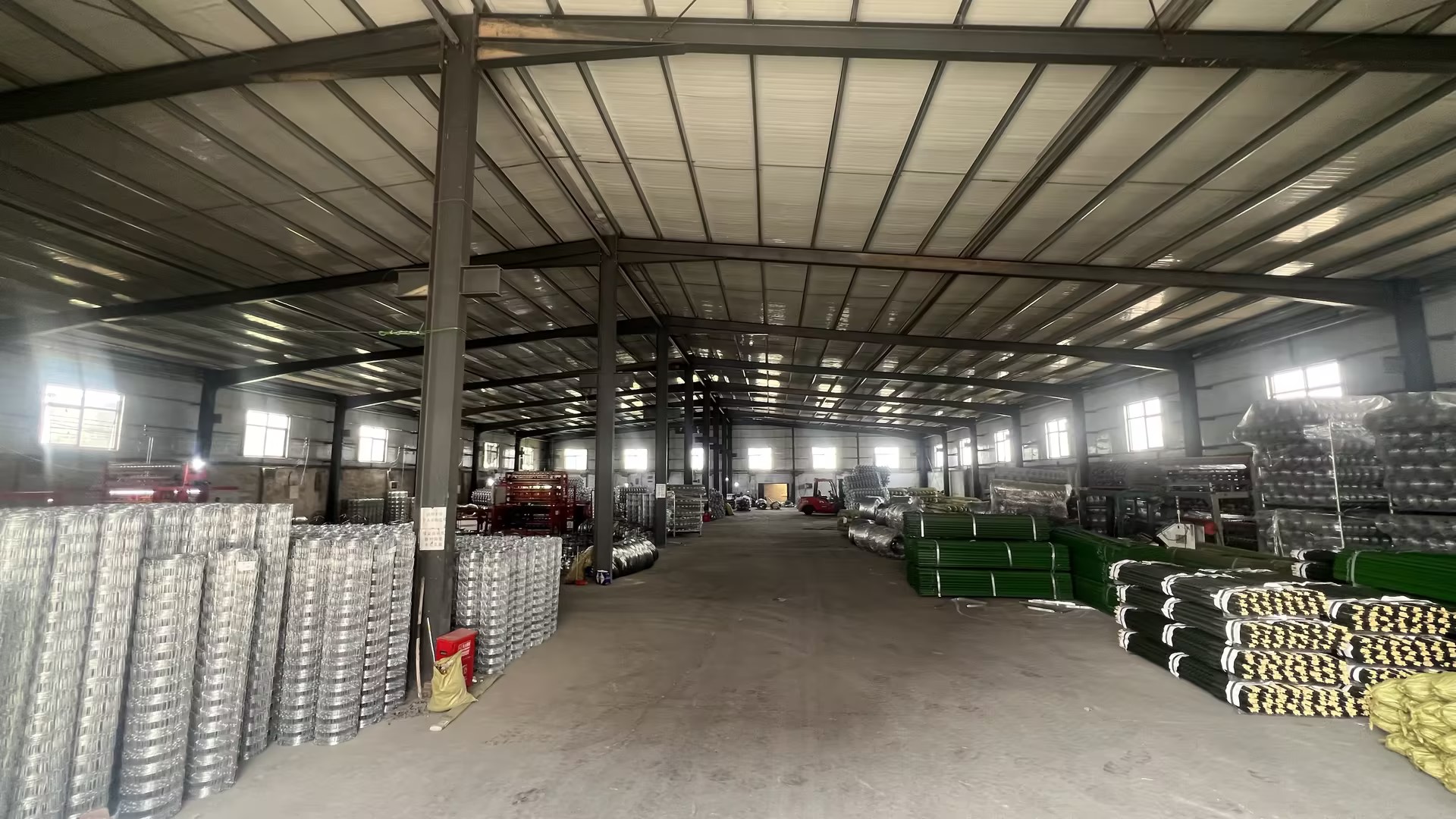
Australia and New Zealand fence to some of the strictest wire standards in the world, and the reason is simple: their climate and their livestock. Long coastal runs, high UV, and large cattle, sheep and deer operations mean a fence that is "galvanised" in a casual sense will not survive, and a fence that does not hold a bull or a stag is worse than no fence at all. If you are buying fence for AU or NZ — or supplying it — the two numbers that matter most are AS/NZS 4534 (zinc-coated wire) and AS/NZS 4680 (hot-dip galvanised steel posts).
At a glance
- Wire: must be hot-dip zinc coated to AS/NZS 4534 — Class W10 standard, or Class W25 for upgraded coastal/long-life projects.
- Posts: Hot Dipped Galvanised / Black Tar Star Pickets to AS/NZS 4680, coated by wall thickness (e.g. ≥45 µm average for 1.5–3 mm wall).
- Spec format: line wires–height–spacing | wire × length, e.g.
7-90-30 | 2.0mm × 200m, edge wires commonly 2.5 mm. - Red line: electro-galvanised wire is not acceptable — it is easily detected and fails the standard.
Why Australia and New Zealand fence differently
Two things set AU/NZ fencing apart from most other markets. First, standards compliance is expected, not optional — an Australian buyer will usually ask for AS/NZS 4534 or AS/NZS 4680 by name, and a receiver can test coating mass on the dock. Second, the coastal environment is brutal: salt air along thousands of kilometres of coastline attacks zinc quickly, and high UV degrades coatings. Combined with large grazing properties where a fence must last decades between repairs, this is why heavier zinc coatings are the norm rather than the upgrade.
For New Zealand, add deer and horse fencing to the picture. Deer are strong jumpers that test a fence hard, which is why Fixed-Knot (deer) and figure-8 (horse) patterns are common there alongside Hinge Joint netting. The same wire standards apply — AS/NZS 4534 covers the whole region.
How AU/NZ fence specs are written
Before you can order, you need to read the spec. In Australia and New Zealand, Hinge Joint fencing is written in a compact industry format:
Number of line wires – height – vertical wire spacing, wire diameter × roll length
For example, 7-90-30 | 2.0mm × 200m means: 7 horizontal line wires, 90 cm high,
30 cm vertical wire spacing, 2.0 mm wire, in a 200 m roll. The industry default in this market is that
the edge wires are upgraded to 2.5 mm, so edge-wire diameter is usually not written
— it is assumed. If you are quoting a buyer, confirm the edge wire; if you are buying, state it
explicitly on the order.
AS/NZS 4534: zinc classes for fence wire
AS/NZS 4534 is the standard for hot-dip zinc-coated steel wire (the zinc is applied to the wire before it is woven into netting). It sets minimum coating masses by finished wire diameter, expressed as zinc classes. For this market the standard classes are W10 (standard) and W25 (upgraded, quoted separately). The table below gives the minimum coating masses in grams per square metre:
| Finished wire diameter | Class W10 (standard) | Class W25 (upgraded) |
|---|---|---|
| >1.55 – 1.80 mm | ≥200 g/m² | ≥500 g/m² |
| >1.80 – 2.24 mm | ≥215 g/m² | ≥540 g/m² |
| >2.24 – 2.72 mm | ≥230 g/m² | ≥575 g/m² |
| >2.72 – 3.15 mm | ≥240 g/m² | ≥600 g/m² |
| >3.15 – 3.55 mm | ≥250 g/m² | ≥625 g/m² |
A useful conversion: coating mass in g/m² ÷ 7.15 ≈ single-side thickness in micrometres. Sampling on finished netting allows a 3% reduction below the table value, rounded to the nearest 5 g/m². Coating is also checked for adhesion — for wire up to 3.8 mm, a wrapping test around a mandrel four times the wire diameter, six close turns, without the coating flaking off.
AS/NZS 4680: coating for Star Pickets
Posts are covered by a different standard. AS/NZS 4680 is the standard for hot-dip galvanised coatings on fabricated steel articles — which is what a Hot Dipped Galvanised Star Picket is. The zinc bath must be at least 98% pure, and the minimum coating thickness depends on the material wall thickness:
| Material wall thickness | Minimum local thickness | Minimum average thickness |
|---|---|---|
| ≤1.5 mm | ≥35 µm | ≥45 µm / 320 g/m² |
| >1.5 – 3 mm | ≥45 µm | ≥55 µm / 390 g/m² |
| >3 – 6 mm | ≥55 µm | ≥70 µm / 500 g/m² |
| >6 mm | ≥70 µm | ≥85 µm / 600 g/m² |
Appearance must be continuous and uniform with no uncoated areas. Verification is by magnetic coating thickness gauge; in case of dispute, the weighing method is used as the referee test. Pre-galvanised strip cannot be substituted for finished-article galvanising on this standard.
AS 2423: the fence product standard
Alongside the wire and coating standards, finished fence products also comply with AS 2423, the Australian standard for wire fence products. In practice this is the product-level standard that the finished netting (hinge-joint, ring-lock and related) is required to meet, and it works together with AS/NZS 4534 — the wire must be Class W10 or W25 hot-dip zinc coated, and the finished netting must meet AS 2423 construction requirements. When you order, ask your supplier to confirm both: the zinc class on the wire and AS 2423 on the finished product.
The red line: electro-galvanised vs hot-dip
There is one line that cannot be crossed in this market. Electro-galvanised wire is not acceptable for AS/NZS 4534. An electro-galvanised coating is only 5–30 g/m² — roughly an order of magnitude thinner than a W10 hot-dip coating — and a receiver can detect it with a simple coating-mass test. If a quote looks suspiciously cheap, this is usually why. Always confirm on the order that the process is hot-dip galvanising (the AS/NZS 4534 code is Z for hot-dip; E for electro is not acceptable).
How to order for Australia and New Zealand
To get an accurate quote and avoid a failed delivery, put these on your purchase order:
- Wire: AS/NZS 4534, hot-dip (Z), zinc class W10 or W25, and the coating mass for your wire diameter.
- Netting format: line wires – height – spacing, wire diameter × length (e.g. 7-90-30 | 2.0mm × 200m), plus edge wire diameter.
- Posts: AS/NZS 4680, and the wall thickness that sets your coating class.
- Testing & marking: ask for mill certificates, coating-mass test results, and per-coil labels showing the standard, class and batch for traceability.
We produce Hinge Joint fencing, Fixed-Knot fencing and Hot Dipped Galvanised Barbed Wire to AS/NZS 4534, and Star Pickets to AS/NZS 4680, and we confirm the process and coating weight before shipment. For more detail on the wire standard, see our guide to AS/NZS 4534 zinc coating, or read about hinge joint vs ring lock to choose the right netting for your stock.
Supplying fence to Australia or New Zealand?
Send us your AS/NZS 4534 / AS/NZS 4680 specification, netting format and quantity and we'll quote factory-direct with mill certificates. Browse the full field fence specifications or send your requirements below.